 Skip to content
A New State of Consciousness Created by Floatation-REST
A new study published in 2026 explores what happens to the mind and body during Floatation-REST.
The researchers found that floating created a distinct non-drug state of consciousness. Participants experienced stronger awareness of breathing and heartbeat, softer boundaries between the body and the surrounding environment, and a greater feeling of unity.
The researchers call this state “aquahenosis” – a feeling of becoming one with the water.
What did the researchers study?
The study was published in Neuroscience of Consciousness, an academic journal from Oxford University Press.
It included 75 adults seeking treatment for anxiety and depression. The participants were randomly assigned to one of three groups:
- Six 60-minute Floatation-REST sessions
- Six Floatation-REST sessions with a more flexible schedule and session length
- Six quiet rest sessions in a zero-gravity chair
A total of 57 participants completed all six sessions.
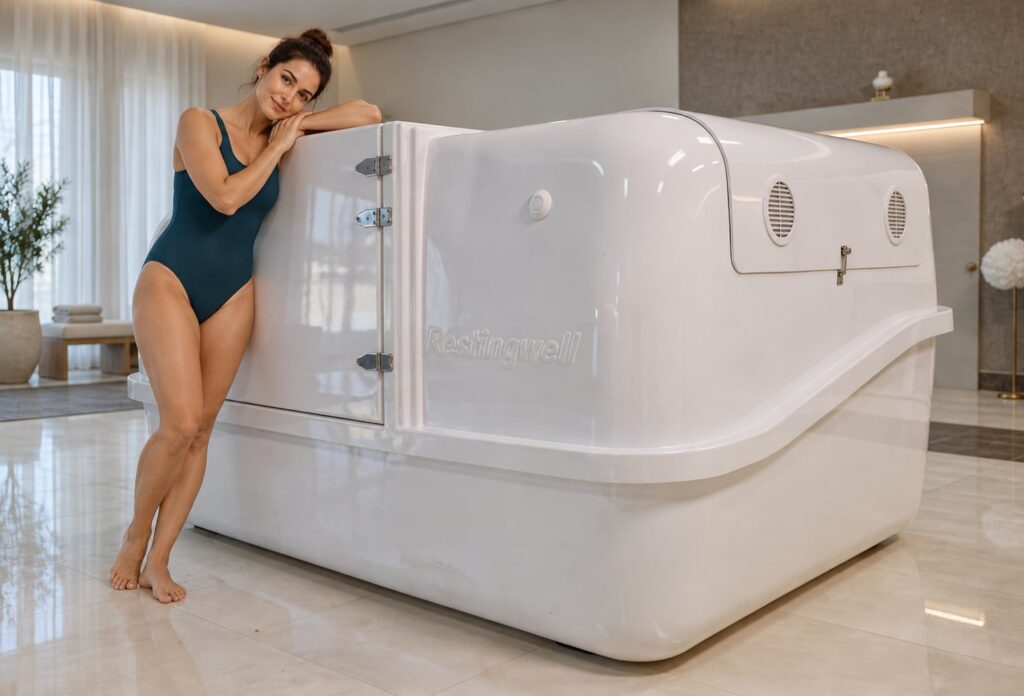
The float environment used warm water with a high concentration of Epsom salt. Light, sound, temperature differences, touch and the normal feeling of gravity were greatly reduced.
What is aquahenosis?
Aquahenosis describes a combination of experiences that appeared during Floatation-REST.
Participants reported:
- A stronger awareness of breathing and heartbeat
- A greater ability to listen to signals from the body
- Increased awareness of the connection between emotions and the body
- A softer boundary between the body and the surrounding water
- A feeling of unity or connection
- Less attention to the outside world
The strongest result was called “Oceanic Boundlessness”. This is a scientific term for a positive and expansive state in which a person may feel peaceful, connected and less separated from the world around them.
Both Floatation-REST groups reported significantly more Oceanic Boundlessness than the chair-based rest group.
The strongest effects were found among participants who could choose the timing and duration of their float sessions. These sessions lasted about 75 minutes on average.
A connection with positive emotion
Oceanic Boundlessness was statistically connected with increased positive emotion and lower depression scores. It was also associated with feeling relaxed, refreshed and free from pain.
However, these findings must be interpreted carefully.
All three groups improved in anxiety, depression and mood. The study did not find clear differences between the groups in the main clinical outcomes. The study therefore does not prove that floating is a treatment or cure for anxiety or depression.
It shows that the experience created by Floatation-REST was different from ordinary chair-based rest.
Is floating similar to psilocybin or ketamine?
The researchers compared the floating experiences with results from earlier studies of psilocybin and ketamine.
There was some overlap in feelings of unity, bliss and softened body boundaries. However, the experiences were not the same.
Psilocybin and ketamine produced much stronger visual imagery and changes in perception. Floatation-REST mainly influenced body awareness, the sense of self and the boundary between the body and the environment.
Floatation-REST therefore appears to offer a non-drug route to certain altered states of consciousness without reproducing the full psychedelic experience.
Longevity, biohacking and recovery
The study did not measure lifespan, biological age or ageing biomarkers. It cannot show that floating helps people live longer.
However, it is relevant to the wider field of longevity and health span. Long-term health is influenced by factors such as recovery, emotional balance, sleep, pain and the ability to regulate stress.
Floatation-REST also offers a different approach to biohacking.
Many biohacking methods add technology, screens, measurements or stimulation. Floating works by removing input. There is no screen to watch and no score to improve during the session.
Warmth, buoyancy and silence create an environment in which attention can turn inward.
In a world built around more stimulation, Floatation-REST may be valuable because it creates space for less.
Scientific source
Tobel T, Cone A, Choquette E, et al. “Aquahenosis: a non-pharmacological altered state of consciousness induced by floatation-REST in individuals with anxiety and depression.” Neuroscience of Consciousness, 2026(1), niag044. Published 26 August 2026.
This was an independent scientific study. It was not conducted using the Restingwell Spirit float tank.